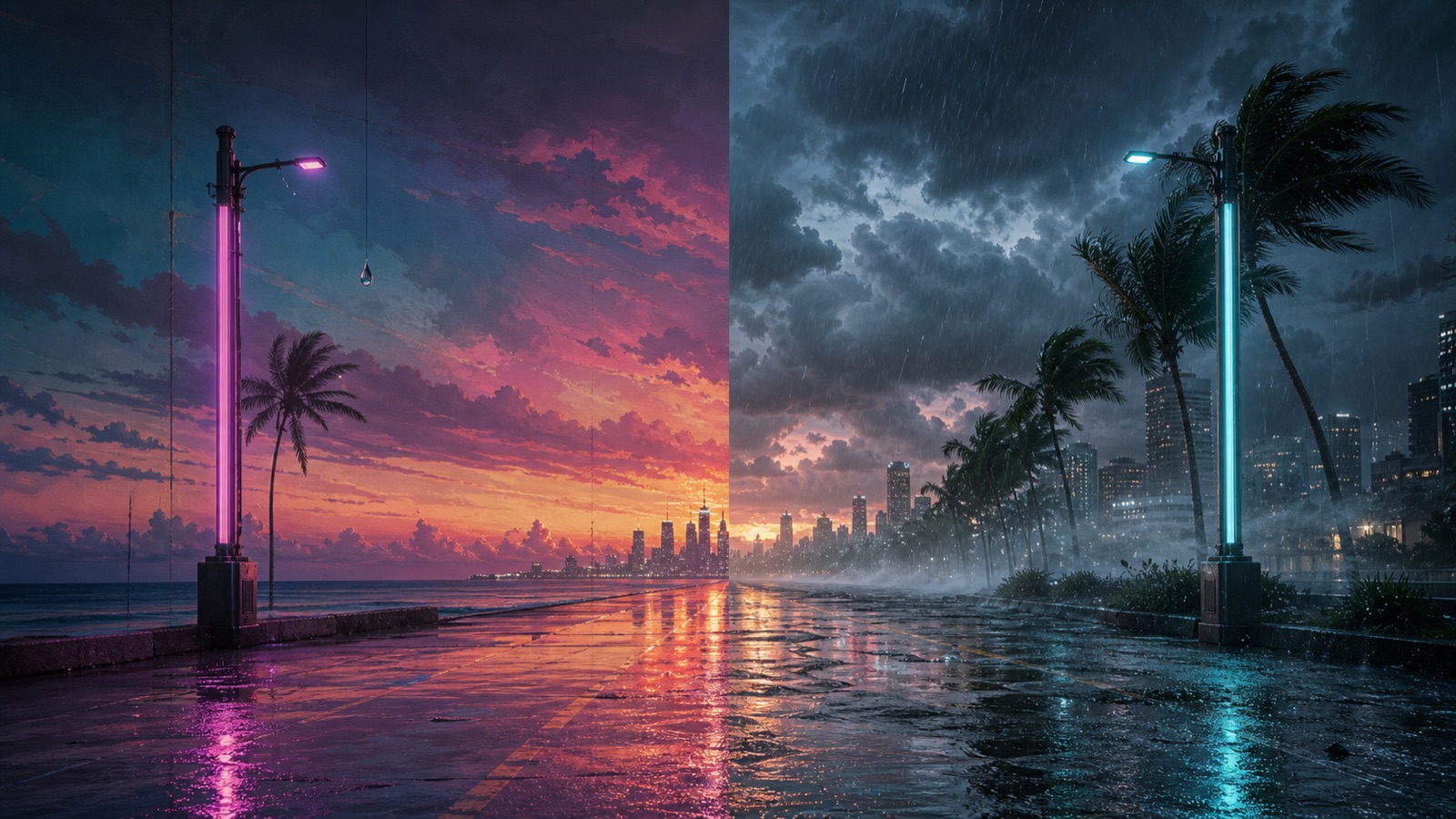
Set Dressing vs. Simulation: How to Tell If a Game's Weather Actually Matters
You asked me whether the rain matters. I'm going to answer the better question, because it's the one that keeps you alive: is this weather a system, or is it a screensaver? Because those are two completely different games, and if you can't tell which one you're in, you'll either ignore something that's killing you or waste effort respecting something that's just décor. The cheap brain's read: most players never run this test, and most players die in the rain confused about why.
Here is the test. It has one question, and everything follows from it.
The one question: does anything get harder?
Weather is set dressing when it changes how the world looks and nothing else. It is simulation when it changes the outcome of what you're doing. That's the whole line. Not "is it pretty" — prettiness is free, every engine can do a wet-look shader. The question is whether the sky has consequences.
So watch one thing. Do something you know the cost of — a corner you always take, a sightline you always trust — and do it again when the weather turns. If nothing changes, you're looking at a screensaver, and you can spend your attention elsewhere. If your familiar corner suddenly spins you out, congratulations: every forecast in this game is now tactical information, and you've been ignoring a whole layer of the map.
The three tells that separate the two
Traction. The most common real weather system in driving-heavy worlds. Wet roads that actually reduce grip mean your braking distance, your cornering line, and your top-speed-before-you-lose-it all move. If a puddle can spin a pursuing cop into a lamppost — and in the worlds that simulate this, it absolutely can — the water is a mechanic. Test it on a corner you own dry, then take it wet. Your body knows immediately.
Detection. Does fog, heavy rain, or darkness change how far the AI can see you? In a screensaver, the guards spot you at the same range in a downpour as in clear noon. In a system, the storm is a cloak — or a trap, depending on which side of the sightline you're on. If you can walk past a patrol in the fog that would've clocked you in daylight, the weather is doing real work.
Population and schedule. This one's subtle and I love it. In the worlds that take time-of-day seriously, who is on the street changes with the clock and the sky — traffic thins, certain NPCs go home, certain doors close. That's a weather system wearing a wristwatch. If the same corner is packed at noon and empty at 3am, the game is simulating a world, not painting one.
Why you can't just trust how it looks
Here's the swerve I keep making, because it keeps being true: the prettiest rain is often the most cosmetic. Studios pour art budget into weather that reads as weather — screen-space reflections, particle density, the works — long before, and sometimes instead of, wiring it into the physics. So the visual quality of a storm tells you almost nothing about whether it's a mechanic. A gorgeous downpour can be pure screensaver; a modest gray drizzle can be quietly re-writing your traction. Never grade weather on its looks. Grade it on what breaks when it arrives.
What to do once you know
If it's set dressing: enjoy it, and ignore it strategically. Don't slow down for cosmetic rain; you're leaving free speed on the table respecting a screensaver.
If it's a system: the forecast is now part of your planning. You route around the low ground before it floods, you use the fog to move and the clear light to wait, you treat a darkening horizon as a countdown. That's not caution — that's reading pressure instead of reacting to panic, which is the whole discipline of this desk.
The big open worlds on the horizon are being built to blur this line — gulf storms, hurricane seasons, coastal flooding that's meant to change the run, not just the screenshot. When one of those lands, run the test on day one. Do the thing you know the cost of, watch what breaks, and you'll know within a minute whether you're playing a screensaver or a system. My colleague on the Fact-Check Desk would tell you to date that finding and label it, and she'd be right — Jemma marks what's confirmed, I read what it costs you.
Every game handles its climate differently, and the specifics of any one title's weather engine shift with patches — I'm honest that game-specific systems are the lane I'm still sharpening, week over week. Confirm the details of any particular game fresh. The way to read a sky is timeless; the engine under it is not.